Extension Calendar

Tuesday, September 30, 2014

Choosing the Right Seat Is Key!


Making Sure Your Child is Riding Safely on Every Trip
As a follow-up to the earlier  article on Child Passenger Safety Week, here are a few tips for getting the correct child safety seat for your child and installing it correctly in the vehicle.

For a child safety seat to do its job correctly, it has to be:
•           Appropriate for your child’s age and size,
•           Installed properly in your vehicle, and
•           Adjusted to fit your child securely.
Parents are reminded to keep children rear-facing until age two or until the limit of their rear-facing convertible seat, usually 40 pounds or more. Also, children should stay in a 5-point harness system until they are ready to ride in a booster seat. Booster seats are for children who are at least age four and 40 pounds or more and mature enough to sit still in a booster. Finally, keep children in a booster seat until the seat belt fits correctly. This is usually at 4’9” tall and sometime between ages 8 and 12 years old. The average child reaches 4’9” at age 11!
If you’re a parent or caregiver, don’t miss this opportunity to have a free child safety seat inspection by a certified child passenger safety technician. Technicians can provide hands-on advice and instruction. Make sure your children are safe and you are in compliance with the current child safety seat law in Texas. The law requires all children under 8, unless taller than 4’9”, to be in a child safety seat system, which includes traditional child safety seats with harnesses and booster seats.
Remember: All child passengers under age 13 should ride securely restrained in the back seat, where they are safest -- every trip, every time. If you are not able to attend an event during National Child Passenger Safety Week, you don’t have to wait until next year to check if your car seat is properly installed. To locate a certified Child Passenger Safety Technician in Texas, go to http://buckleup.tamu.edu.
Follow these guidelines from NHTSA to keep your children riding safely:
•           Birth – 12 months: For the best possible protection, your child under age 1 should always ride in a rear-facing car seat. There are different types of rear-facing car seats; infant-only seats can only be used rear-facing. Convertible and 3-in-1 car seats typically have higher height and weight limits for the rear-facing position, allowing you to keep your child rear-facing for a longer period of time.
•           1 – 3 years: Your child should remain in a rear-facing car seat until he or she reaches the top height or weight limit allowed by your car seat’s manufacturer. This may result in many children riding rear-facing to age 2 or older. Once your child outgrows the rear-facing car seat, your child is ready to travel in a forward-facing car seat with a harness.
•           4 – 7 years: Keep your child in a forward-facing car seat with a harness until he or she reaches the top height or weight limit allowed by your car seat’s manufacturer. Once your child outgrows the forward-facing car seat with a harness, it’s time to travel in a booster seat, but still in the back seat.
•           8 – 12 years: Keep your child in a booster seat until he or she is big enough to fit in a seat belt properly. For a seat belt to fit properly, the lap belt must lie snugly across the upper thighs, not the stomach. The shoulder belt should lie snugly across the shoulder and chest and not cross the neck or face. Children under 13 should ride in the back seat!

For more information about this and other Extension and 4-H programming, contact your friendly, local county Extension agent Abigail Pritchard at 432-943-4112. Information is also available on our website at ward.agrilife.org. We are also on Facebook at www.facebook.com/wardcounty4h.

Monday, September 15, 2014

Stay inside the loop with our new text message update service!

These days we have more ways of communicating than we have had in all of our history, and even way more than we had even 10 years ago!

One of the new tools we have to keep everyone up to speed on whats going on in 4-H is our new text message update service. If you subscribe to this service, you will receive reminders on your cell phone on events and deadlines coming up.

Follow the instructions below and feel free to call us if you have problems.

We recommend that everyone subscribe to the General Feed, since that will be the feed we will use to remind everyone about club meetings and other county-wide events. From there you can subscribe to any of the other feeds in which you participate. 


Making Sure Your Child is Riding Safely on Every Trip


Making Sure Your Child is Riding Safely on Every Trip
September 14-20 is National Child Passenger Safety Week

Every parent wants the best for their child, but when it comes to keeping their child safe in the car, there is often confusion surrounding which car seat is safest and how to use it correctly. The problem is that keeping them safe in vehicles isn’t as easy as it might appear. Nationally, it is reported that 3 out of 4 car seats are not used correctly. For a car seat to best protect your child, it must be the one that fits your child, your vehicle, and that you will use correctly every time you travel. National Child Passenger Safety Week will be celebrated from September 14-20th and provides an opportunity for parents to make sure they are transporting their children safely. This year’s campaign is also putting an emphasis on making sure your car seat is registered so you will be notified of any recalls, as well as stressing the importance of keeping children under 13 riding correctly restrained in the back seat!
Children are at greater risk than adults in a vehicle crash. In fact, motor vehicle crashes are the number one cause of death for children. Crash data from the National Highway Transportation Safety Administration shows that, on average in 2012, nearly two children under the age of 13 were killed and 332 were injured every day while riding in cars, SUVs, pickups, and vans. Unfortunately in 2012, over one third (37%) of children killed in car crashes were not in car seats, booster seats, or seat belts.
Securing your children properly in age- and size-appropriate child safety seats — in the back seat of your vehicle — is the most effective thing you can do to protect them in the event of a crash. In fact, in motor vehicle crashes, child safety seats reduce the risk of fatal injury by 71 percent for infants and by 54 percent for toddlers. Misuse of car seats can cause needless injuries and fatalities.
That’s why Texas A&M AgriLife Extension Service agent Abigail Pritchard is urging all parents and caregivers to take the opportunity to have their car seat inspected by a certified child passenger safety technician. There is no charge for inspections. To locate a certified technician in your area, go to http://buckleup.tamu.edu or to find an event during National Child Passenger Safety Week go to http://seatcheck.org.

For more information about this and other Extension and 4-H programming, contact your friendly, local county Extension agent Abigail Pritchard at 432-943-4112. Information is also available on our website at ward.agrilife.org. We are also on Facebook at www.facebook.com/wardcounty4h.

Wednesday, September 10, 2014

Avoid Pecan Water Stress


Avoid Pecan Water Stress  
By Larry A. Stein, Extension Horticulturist

The dog days of summer have finally set in! We can all feel the effect of heat stress by walking from an air conditioned office to our cars in the afternoon, so imagine how much water those massive pecan trees need each day to survive such heat.

A pecan tree needs about 100 to 200 gallons of water per day from April through October, which translates into about 2 inches of water every week. Most of the water is lost to transpiration through the stomates, or leaf pores. This transpiration allows the leaves to stay cool and not burn up from the summer heat and enables the tree to make food to feed itself and developing nuts.

There are two critical stages of development in pecan production which require adequate water. The first is early in the season, when the nuts grow to full size (around the end of July); good moisture at this time will mean large pecan size. Since the pecan’s kernels are developed late in the season, late summer and early fall watering is a necessity for well filled kernels. Water will be needed right up until shuck split to not only fill the nuts but also to promote shuck opening. Current research has shown that water stress tends to inhibit shuck opening.

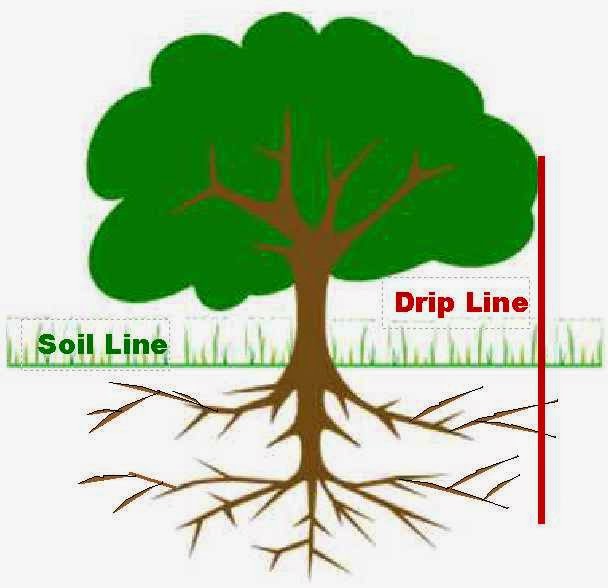
Water should be applied at the drip line of the pecan tree, not at the trunk. It should be a slow, soaking watering since most of the feeder roots are in the top 12 to 24 inches of the soil. Try to wet at least as much soil as is covered by the shadow of the leaf canopy at high noon.

The most recent research indicates that water stress affects nut size, quality, number of viviparous nuts (nuts which germinate while still in the shuck), number of sticktights (nuts which fail to develop and open), as well as the following year’s crop. One of the most significant findings of recent irrigation studies on pecans indicates that the trees’ high water requirement does not end at the end of August or September, but continues up until a week before shuck split. Hence, growers are urged to water late in the season with at least 2 inches of water per week per acre of trees. To a home owner, this represents about 1,000 to l,500 gallons of water per tree, depending on tree size, up until the time of shuck split.

Pecan trees must be watered at least every two weeks; a three week drought is the maximum trees can endure without being damaged. Any stress received by pecan trees during this late stage of development can result in major fruit drop. Some trees can lose up to one-half of their crop if not properly managed during late summer and early autumn.

(For more information on how to water your Pecan Tree, see last week's post on Tree Irrigation)

Monday, September 8, 2014

4-H Feeder Meetings to focus on "Quality Counts"


As in the past, this year we will be holding 4-H Feeder Meetings in the fall for 4-H livestock feeders and their parents. This year, we will be including aspects from the Quality Counts program in our meetings.

“Quality Counts” is designed to teach young people the importance of displaying good character in carrying out livestock projects, and in every aspect of their lives. “Quality Counts” helps them learn the importance of using proper livestock management practices so that food quality and safety are preserved.

All exhibitors who plan on attending a major stock show in the spring are required to participate in the curriculum and pass a verification exam before entering the show in November. 

These meetings will have information relevant to all exhibitors no matter the species they show or their experience level. The dates for this year's meetings will be:

TUESDAY, SEPTEMBER 23RD -  Making Good Decisions &Setting Goals for  Livestock Projects

TUESDAY, OCTOBER 14TH - Producing a Safe Product for the Food Industry

TUESDAY, OCTOBER 28TH - Proper Animal Health Care

All meetings will be held at the Bentley 4-H Center at 7 PM.


Wednesday, September 3, 2014

How to Water Your Trees

HOW TO WATER TREES
C.L. Eaton, County Extension Agent - Agriculture/Natural Resources

Throughout the summer I have gone on several site visits of folks who are having problems with their trees in their yard. The majority of the time, the problem is either A) the tree is not getting watered enough/at all and/or B) the tree is not being watered properly.

West Texas is hard on Trees. The average life cycle of a shade tree in our part of the country is 15 years. Many trees that are planted here are natives of areas that get much more rainfall than Ward County does, and therefore need ample irrigation. 

One of the biggest misconceptions when it comes to watering trees is that you need to water the tree at the trunk. Tree roots shoot our horizontally from the tree trunk and expand out to about where the edge of the canopy of the tree is. This is called the drip line. This is where the tree absorbs most of the moisture it needs to sustain itself, therefore this is where you should apply irrigation. 
FIGURE 1: Drip Line Illustration


For more information on the proper technique of watering trees, watch this video from our colleagues at the Texas A&M Forest Service: